


Magnetic susceptibility is a fundamental concept in the study of magnetism, which describes how a material responds to an applied magnetic field. When it comes to Alnico bar magnets, understanding their magnetic susceptibility is crucial for various applications, from industrial machinery to scientific research. As a supplier of Alnico Bar Magnets, I'm excited to delve into this topic and share some insights.
Understanding Magnetic Susceptibility
Magnetic susceptibility, denoted by the Greek letter χ (chi), is a dimensionless quantity that measures the degree of magnetization of a material in response to an applied magnetic field. It indicates whether a material is attracted (paramagnetic), repelled (diamagnetic), or strongly magnetized (ferromagnetic) by an external magnetic field.
A positive susceptibility value indicates that the material is paramagnetic or ferromagnetic. Paramagnetic materials have a weak positive susceptibility, meaning they are weakly attracted to a magnetic field. Ferromagnetic materials, on the other hand, have a large positive susceptibility and can be strongly magnetized. A negative susceptibility value corresponds to diamagnetic materials, which are weakly repelled by a magnetic field.
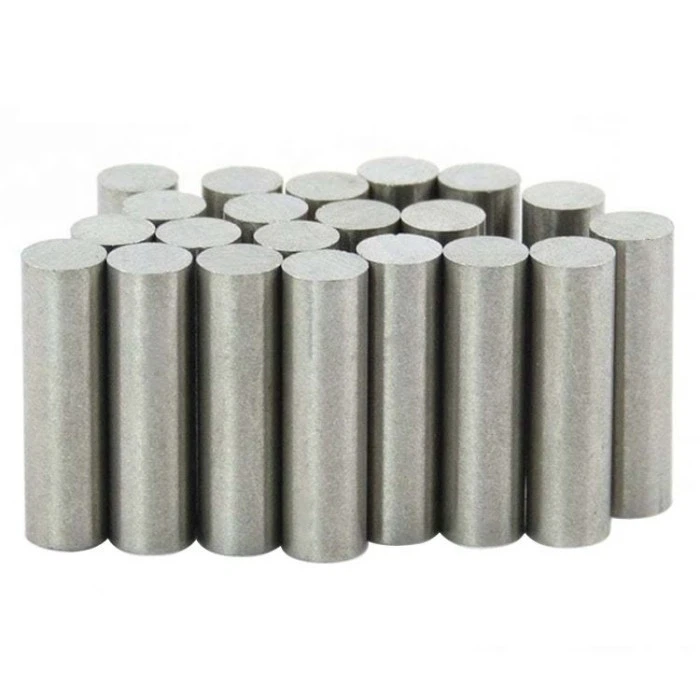

Alnico: A Ferromagnetic Material
Alnico is an alloy composed primarily of aluminum (Al), nickel (Ni), and cobalt (Co), along with smaller amounts of other elements such as iron (Fe), copper (Cu), and titanium (Ti). Alnico magnets are known for their high magnetic strength, excellent temperature stability, and corrosion resistance. They belong to the class of ferromagnetic materials, which means they have a large positive magnetic susceptibility.
The ferromagnetic properties of Alnico are due to the alignment of its atomic magnetic moments. In a ferromagnetic material, the atomic magnetic moments tend to align parallel to each other, creating a net magnetic moment even in the absence of an external magnetic field. This alignment is maintained over relatively large regions called magnetic domains. When an external magnetic field is applied, these domains can be further aligned, resulting in a significant increase in the magnetization of the material.
Magnetic Susceptibility of Alnico Bar Magnets
The magnetic susceptibility of an Alnico bar magnet depends on several factors, including its composition, microstructure, and the strength of the applied magnetic field. In general, the magnetic susceptibility of Alnico is relatively high compared to other materials, due to its ferromagnetic nature.
The exact value of the magnetic susceptibility of an Alnico bar magnet can vary depending on the specific grade of Alnico. Different grades of Alnico have different compositions and microstructures, which can affect their magnetic properties. For example, some grades of Alnico are optimized for high coercivity (resistance to demagnetization), while others are designed for high remanence (residual magnetization).
Typically, the magnetic susceptibility of Alnico bar magnets is in the range of several hundred to several thousand. This high susceptibility allows Alnico bar magnets to be strongly magnetized by an external magnetic field and to retain their magnetization even after the field is removed.
Applications of Alnico Bar Magnets
The high magnetic susceptibility and excellent magnetic properties of Alnico bar magnets make them suitable for a wide range of applications. Some common applications of Alnico bar magnets include:
- Industrial Machinery: Alnico bar magnets are used in various industrial machinery, such as motors, generators, and sensors. Their high magnetic strength and temperature stability make them ideal for these applications, where reliable and consistent magnetic performance is required.
- Audio Equipment: Alnico bar magnets are also used in audio equipment, such as loudspeakers and microphones. Their high magnetic strength and low distortion make them suitable for producing high-quality sound.
- Scientific Research: Alnico bar magnets are used in scientific research, such as in magnetic resonance imaging (MRI) and particle accelerators. Their high magnetic strength and stability make them useful for creating strong and uniform magnetic fields.
- Magnetic Separation: Alnico bar magnets are used in magnetic separation applications, such as separating ferrous materials from non-ferrous materials. Their high magnetic strength and ability to attract ferrous materials make them effective for this purpose.
As a Supplier of Alnico Bar Magnets
As a supplier of Alnico Bar Magnet, we offer a wide range of high-quality Alnico bar magnets to meet the needs of our customers. Our Alnico bar magnets are available in various sizes, shapes, and grades, and can be customized to meet specific requirements.
We understand the importance of providing our customers with reliable and consistent magnetic products. That's why we use the latest manufacturing techniques and quality control measures to ensure that our Alnico bar magnets meet the highest standards of quality and performance.
In addition to Alnico bar magnets, we also offer other types of Alnico magnets, such as Alnico Rod Magnet and Alnico Ring Magnet. Our comprehensive product range allows us to provide our customers with a one-stop solution for all their magnetic needs.
Contact Us for Your Alnico Magnet Needs
If you are interested in purchasing Alnico bar magnets or have any questions about our products, please feel free to contact us. Our team of experts is always ready to assist you and provide you with the information you need. We look forward to working with you and helping you find the right magnetic solution for your application.
References
- Cullity, B. D., & Graham, C. D. (2008). Introduction to Magnetic Materials. Wiley-IEEE Press.
- O'Handley, R. C. (2000). Modern Magnetic Materials: Principles and Applications. Wiley.
- Bozorth, R. M. (1951). Ferromagnetism. Van Nostrand.


