


Hey there! I'm super stoked to talk to you about the difference between a regular magnet and a Magnet Halbach Array. As a supplier of Magnet Halbach Arrays, I've seen firsthand how these arrays can be game - changers in a whole bunch of applications.
Let's start with the basics. A regular magnet, like the ones you might stick on your fridge, is pretty straightforward. It has a north pole and a south pole. The magnetic field lines come out of the north pole and go into the south pole, creating a simple magnetic field pattern around it. This field is relatively uniform in a small area close to the magnet, but it weakens pretty quickly as you move away from it.
On the other hand, a Magnet Halbach Array is a whole different ballgame. It's an arrangement of permanent magnets that creates a stronger and more focused magnetic field on one side while significantly reducing the field on the other side. This unique property is what makes Halbach Arrays so special.
The key to the Halbach Array's magic lies in its Halbach Array Arrangement. In a Halbach Array, the magnets are arranged in a specific pattern where the magnetization direction of each magnet is carefully chosen. This arrangement causes the magnetic fields of the individual magnets to add up constructively on one side and cancel out on the other side.
One of the most obvious differences between a regular magnet and a Halbach Array is the strength of the magnetic field. A Halbach Array can generate a much stronger magnetic field compared to a single regular magnet of the same size. This is because the array is designed to concentrate the magnetic field in a particular direction, rather than having it spread out in all directions like a regular magnet.
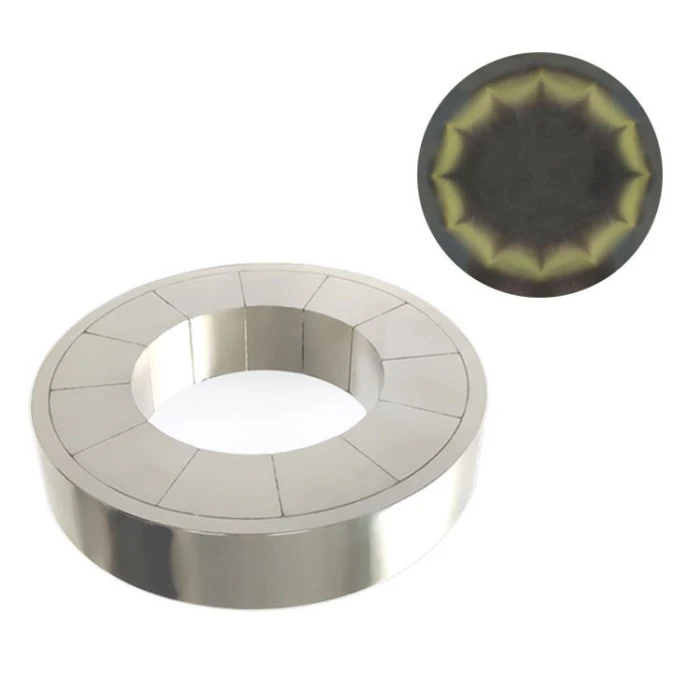

Another big difference is the field distribution. With a regular magnet, the magnetic field is symmetrically distributed around the magnet. But in a Halbach Array, the field is highly asymmetric. You get a very strong field on one side and a very weak field on the other. This can be incredibly useful in applications where you want to have a strong magnetic effect in one area while minimizing interference in other areas.
Let's talk about some of the different types of Halbach Arrays. There are Linear Halbach Arrays and Cylindrical Halbach Arrays.
A Linear Halbach Array consists of a row of magnets arranged in the Halbach pattern. It creates a strong, uniform magnetic field along a straight line. This type of array is often used in linear motors, magnetic levitation systems, and particle accelerators. In a linear motor, for example, the strong and focused magnetic field of the Halbach Array can provide more efficient and precise motion control compared to using regular magnets.
A Cylindrical Halbach Array, as the name suggests, has a cylindrical shape. It's made up of magnets arranged in a circular pattern to create a strong magnetic field inside the cylinder while keeping the external field very weak. This type of array is commonly used in magnetic resonance imaging (MRI) machines, where it can help to generate a strong and uniform magnetic field for high - quality imaging.
Now, let's think about the practical implications of these differences. In terms of efficiency, Halbach Arrays are often more efficient than regular magnets. Because they can focus the magnetic field where it's needed, less energy is wasted in creating magnetic fields in unwanted areas. This can lead to lower power consumption and better performance in devices that use magnetic fields.
In applications where space is limited, Halbach Arrays also have an edge. Since they can generate a strong magnetic field in a smaller volume compared to regular magnets, they can be a great choice for compact designs. For example, in small electronic devices or portable sensors, a Halbach Array can provide the necessary magnetic field strength without taking up too much space.
When it comes to cost, it's a bit more complicated. Regular magnets are generally cheaper and more readily available. However, the increased performance and efficiency of Halbach Arrays can sometimes justify the higher cost. In applications where high - performance is crucial, such as in high - end medical equipment or advanced research facilities, the benefits of using a Halbach Array often outweigh the additional expense.
So, if you're in the market for a magnetic solution, you need to think about your specific requirements. If you just need a simple magnetic force in a general area, a regular magnet might be the way to go. But if you need a strong, focused magnetic field, high efficiency, and the ability to control the field distribution precisely, then a Magnet Halbach Array could be the perfect choice.
As a Magnet Halbach Array supplier, I've worked with all sorts of customers, from small startups working on innovative projects to large corporations in the aerospace and automotive industries. I know how important it is to have the right magnetic solution for your application. Whether you're looking for a custom - designed Halbach Array or a standard off - the - shelf product, I can help you find the best fit.
If you're interested in learning more about Magnet Halbach Arrays or want to discuss a potential project, I'd love to hear from you. Just reach out, and we can start a conversation about how a Halbach Array can meet your needs and take your project to the next level.
References
- "Magnetic Fields and Forces" by David J. Griffiths
- "Permanent Magnet and Electromechanical Devices: Materials, Analysis, and Applications" by J. R. Hendershot Jr. and T. J. E. Miller


