


As a supplier of Mn - Zn Ferrite Core, I often get asked about the resistivity of this remarkable material. Resistivity is a fundamental property that plays a crucial role in the performance of Mn - Zn Ferrite Core, and understanding it can help customers make informed decisions when it comes to their applications.
What is Resistivity?
Resistivity, denoted by the Greek letter ρ (rho), is a measure of how strongly a material opposes the flow of electric current. It is defined as the resistance (R) of a unit length (l) of the material with a unit cross - sectional area (A), and is given by the formula ρ = R×(A/l). The unit of resistivity is the ohm - meter (Ω·m).
In the context of electrical materials, resistivity is an important parameter. Materials with high resistivity are poor conductors of electricity, while those with low resistivity are good conductors. For magnetic materials like Mn - Zn Ferrite Core, resistivity is especially significant as it affects the eddy current losses.
Resistivity of Mn - Zn Ferrite Core
Mn - Zn Ferrite Core is a type of soft magnetic material composed mainly of manganese (Mn), zinc (Zn), and iron (Fe) oxides. It has a relatively high resistivity compared to metallic magnetic materials. The resistivity of Mn - Zn Ferrite Core typically ranges from about 10⁻² to 10² Ω·m, depending on its composition, manufacturing process, and operating conditions.

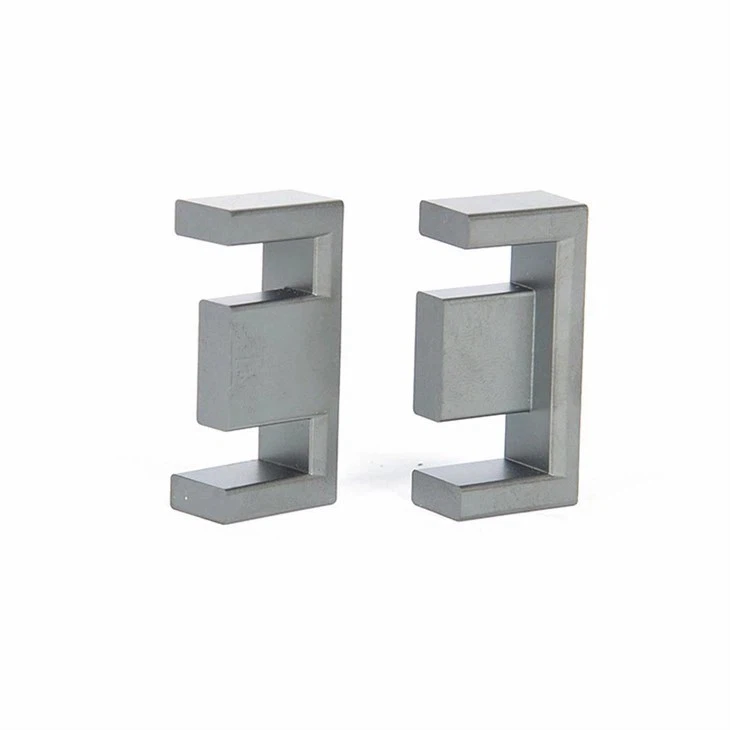
The high resistivity of Mn - Zn Ferrite Core is one of its key advantages. Eddy currents are induced in a magnetic material when it is exposed to a changing magnetic field. These eddy currents can cause power losses in the form of heat, which is undesirable in many applications. Since Mn - Zn Ferrite Core has a high resistivity, the flow of eddy currents is restricted, resulting in lower eddy current losses. This makes it suitable for high - frequency applications where minimizing power losses is crucial.
Factors Affecting the Resistivity of Mn - Zn Ferrite Core
Composition
The exact ratio of manganese, zinc, and iron oxides in the Mn - Zn Ferrite Core can significantly affect its resistivity. Different compositions can lead to different crystal structures and electronic properties, which in turn influence the material's ability to conduct electricity. For example, increasing the zinc content in the ferrite can generally increase the resistivity to a certain extent. However, the optimal composition is a balance between resistivity and other magnetic properties such as permeability and saturation magnetization.
Manufacturing Process
The manufacturing process of Mn - Zn Ferrite Core also plays a vital role in determining its resistivity. Processes such as sintering temperature, sintering time, and atmosphere can affect the grain size, density, and defect structure of the ferrite. A well - controlled manufacturing process can produce a ferrite core with a more uniform microstructure, which is beneficial for achieving a consistent and desirable resistivity. For instance, a higher sintering temperature may lead to larger grain sizes, which can sometimes increase the resistivity.
Temperature
Temperature has a significant impact on the resistivity of Mn - Zn Ferrite Core. As the temperature increases, the resistivity of the ferrite generally decreases. This is because at higher temperatures, the thermal energy causes more electrons to be excited into the conduction band, increasing the conductivity of the material. However, this temperature - dependent behavior needs to be carefully considered in applications, especially those that operate over a wide temperature range.
Applications of Mn - Zn Ferrite Core Based on Resistivity
Power Transformers
In power transformers, Mn - Zn Ferrite Core is widely used due to its high resistivity and good magnetic properties. At high frequencies, the low eddy current losses associated with the high resistivity of the ferrite core make it possible to design more efficient transformers. These transformers can convert electrical energy with less power loss, which is essential for reducing energy consumption and improving the overall performance of the power system.
Inductors
Inductors are another important application of Mn - Zn Ferrite Core. The high resistivity of the ferrite helps to reduce the eddy current losses in the inductor, especially at high frequencies. This allows inductors to store and release magnetic energy more efficiently, which is crucial in applications such as switching power supplies, where high - frequency operation is common.
EMI Filters
Electromagnetic interference (EMI) filters are used to suppress unwanted electromagnetic noise in electronic circuits. Mn - Zn Ferrite Core is an ideal material for EMI filters because of its high resistivity and magnetic properties. The high resistivity helps to prevent the flow of eddy currents, while the magnetic properties allow the ferrite core to absorb and dissipate the electromagnetic energy of the noise signals.
Our Offerings as a Mn - Zn Ferrite Core Supplier
As a leading supplier of Mn-zn Ferrite Core Magnet, we are committed to providing high - quality products with excellent resistivity characteristics. Our MnZn Ferrite Core is manufactured using advanced processes and strict quality control measures to ensure consistent and reliable performance.
We offer a wide range of Mn - Zn Ferrite Core products with different compositions and specifications to meet the diverse needs of our customers. Whether you need a ferrite core for high - frequency power applications or EMI filtering, we can provide you with the right solution. Our experienced technical team can also offer customized design and technical support to help you optimize your application.
Contact Us for Procurement
If you are interested in our Mn-zn Ferrite Core Magnet products and would like to discuss your specific requirements, please feel free to contact us. We are always ready to engage in procurement discussions and provide you with detailed product information and competitive pricing. Our goal is to establish long - term partnerships with our customers by delivering high - quality products and excellent service.
References
- Smit, J., & Wijn, H. P. J. (1959). Ferrites: Physical Properties of Ferromagnetic Oxides in Relation to Their Technical Applications. Wiley.
- Cullity, B. D., & Graham, C. D. (2008). Introduction to Magnetic Materials. Wiley - Interscience.
- O'Handley, R. C. (2000). Modern Magnetic Materials: Principles and Applications. Wiley.


