


As a supplier of Disc Magnetic Couplings, I often get asked about various technical aspects of our products. One question that comes up quite frequently is: "What is the moment of inertia of disc magnetic coupling?" In this blog post, I'll delve into this topic, explaining what moment of inertia is, how it applies to disc magnetic couplings, and why it matters in practical applications.
Understanding Moment of Inertia
Before we discuss the moment of inertia of disc magnetic couplings, let's first understand what moment of inertia is in general. Moment of inertia, denoted by (I), is a measure of an object's resistance to changes in its rotational motion. It is analogous to mass in linear motion; just as mass determines how difficult it is to accelerate an object in a straight - line, moment of inertia determines how difficult it is to change the angular velocity of a rotating object.
Mathematically, for a discrete system of particles, the moment of inertia is given by (I=\sum_{i = 1}^{n}m_{i}r_{i}^{2}), where (m_{i}) is the mass of the (i) - th particle and (r_{i}) is the perpendicular distance of the (i) - th particle from the axis of rotation. For a continuous object, the moment of inertia is calculated using integral calculus: (I=\int r^{2}dm), where the integral is taken over the entire mass of the object.
Moment of Inertia of a Disc
A disc is a common shape in many mechanical components, including disc magnetic couplings. For a solid disc of mass (M) and radius (R) rotating about an axis perpendicular to the plane of the disc and passing through its center, the moment of inertia is given by (I=\frac{1}{2}MR^{2}). This formula is derived by considering the disc as a collection of infinitesimal rings and integrating over the entire area of the disc.
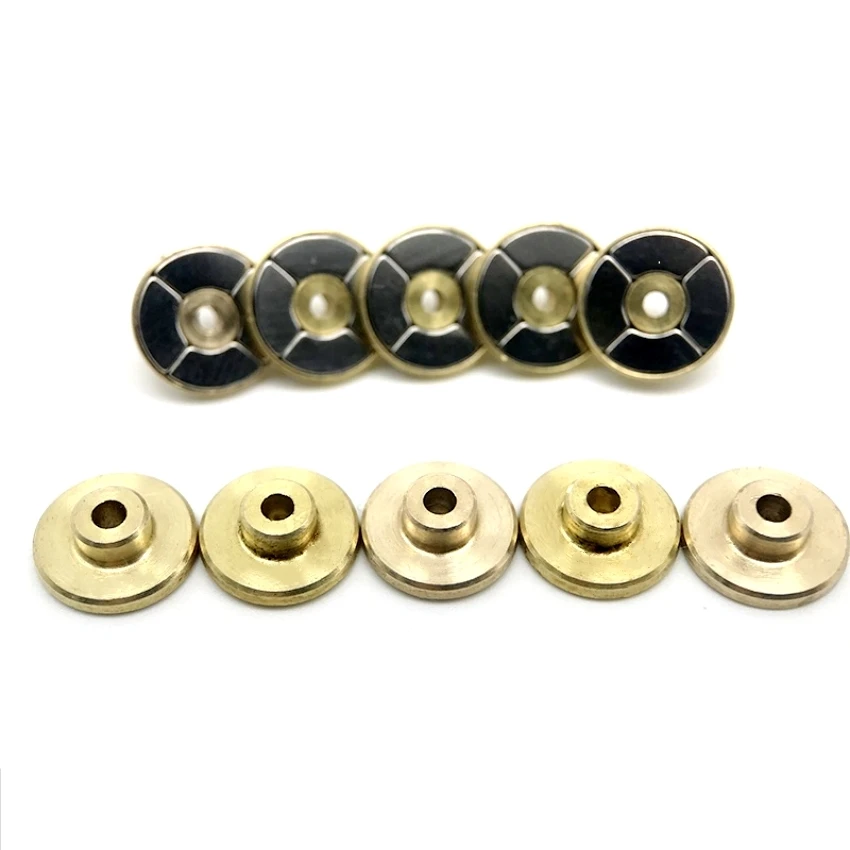
In the context of disc magnetic couplings, the disc may not be a simple solid disc. It could have holes, cut - outs, or a non - uniform mass distribution due to the presence of magnets and other components. In such cases, calculating the moment of inertia becomes more complex. One approach is to break the disc into smaller, simpler shapes for which the moment of inertia formulas are known, and then sum up the moments of inertia of these individual shapes.

Moment of Inertia in Disc Magnetic Couplings
In a disc magnetic coupling, the moment of inertia plays a crucial role in determining the dynamic performance of the coupling. When the coupling is used to transmit torque between two rotating shafts, the moment of inertia affects how quickly the system can accelerate or decelerate.
A higher moment of inertia means that more torque is required to change the rotational speed of the coupling. This can be both an advantage and a disadvantage depending on the application. In applications where a smooth and stable rotation is required, a higher moment of inertia can help to dampen out fluctuations in the input torque. For example, in some industrial machinery, a disc magnetic coupling with a relatively high moment of inertia can prevent sudden changes in speed that could damage the equipment.
On the other hand, in applications where rapid acceleration and deceleration are needed, a lower moment of inertia is preferred. For instance, in high - speed precision machines, a coupling with a low moment of inertia allows for faster response times and more accurate control of the rotational speed.
Factors Affecting the Moment of Inertia of Disc Magnetic Couplings
Several factors can affect the moment of inertia of disc magnetic couplings:
- Mass: As the mass of the disc increases, the moment of inertia also increases. This is because moment of inertia is directly proportional to mass. In disc magnetic couplings, the mass can be influenced by the materials used, the size of the disc, and the presence of additional components such as magnets.
- Radius: The moment of inertia is proportional to the square of the radius. Therefore, increasing the radius of the disc has a significant impact on the moment of inertia. Designers need to carefully consider the radius of the disc when optimizing the moment of inertia for a particular application.
- Mass Distribution: The way the mass is distributed within the disc also affects the moment of inertia. A disc with most of its mass concentrated near the outer edge will have a higher moment of inertia than a disc with the same mass but a more uniform distribution. In disc magnetic couplings, the placement of magnets and other components can be adjusted to control the mass distribution and thus the moment of inertia.
Practical Considerations for Design and Selection
When designing or selecting a disc magnetic coupling, it is important to consider the moment of inertia in relation to the overall system requirements. Here are some practical tips:
- Understand the Application: Determine the required acceleration and deceleration rates, as well as the level of torque that needs to be transmitted. This will help you decide whether a high or low moment of inertia is more suitable for your application.
- Optimize the Design: Work with an experienced engineering team to optimize the design of the disc magnetic coupling. They can use advanced modeling and simulation techniques to calculate the moment of inertia and make adjustments to the design to meet your specific requirements.
- Consider the Trade - offs: There is often a trade - off between moment of inertia and other performance factors such as torque capacity, efficiency, and cost. Make sure to consider all these factors when making your decision.
Our Disc Magnetic Couplings
At our company, we offer a wide range of Magnetic Disk Couplings designed to meet the diverse needs of our customers. Our couplings are available in different sizes, materials, and configurations, allowing you to choose the one that best suits your application.
We also provide Magnetic Coupling Drive solutions that are engineered for high performance and reliability. Our Permanent Magnetic Coupling products are designed to provide efficient and maintenance - free operation.
Contact Us for Purchase and Consultation
If you are interested in learning more about our disc magnetic couplings or need help in selecting the right product for your application, we encourage you to contact us. Our team of experts is ready to assist you with any questions you may have and to provide you with a customized solution. Whether you are looking for a coupling with a specific moment of inertia or other performance characteristics, we can work with you to meet your requirements.
References
- Beer, F. P., Johnston, E. R., Mazurek, D. F., & Cornwell, P. J. (2016). Vector Mechanics for Engineers: Dynamics. McGraw - Hill Education.
- Meriam, J. L., & Kraige, L. G. (2012). Engineering Mechanics: Dynamics. John Wiley & Sons.


