


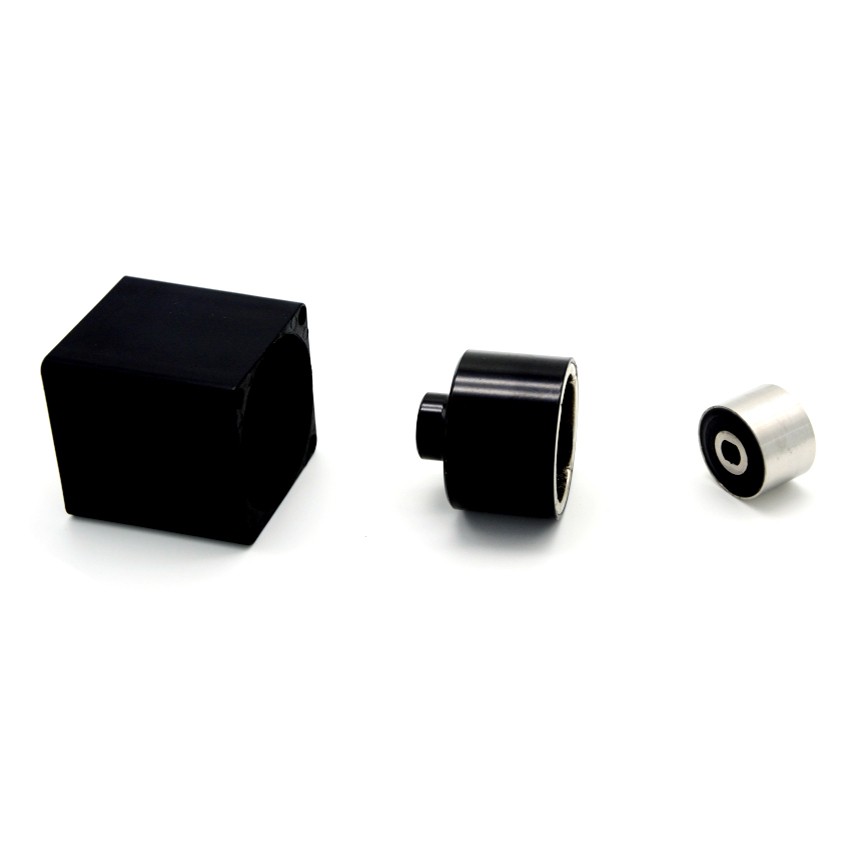


Chongqing Great Wall Technology Co., Ltd. is one of the leading manufacturers and suppliers of magnetic coupling drive in China, also supports customized service. Welcome to wholesale high quality magnetic coupling drive for sale here from our factory.
The pumping element and fluid are housed inside a hermetically sealed housing in a magnetic drive pump. An assembly of magnets on the outside of the housing is rotated by the driving shaft from the motor. A corresponding ring of magnets on the pump shaft is in opposition to this on the inside of the housing (Figure 1). Due to the paired magnets, torque is transmitted through the housing. The most significant benefit of a magnetic coupling is that it dispenses with the need for rotating seals and their related issues with leakage, potential contamination, and ongoing maintenance to transmit torque through a barrier.
The basic principles and benefits of magnetic coupling drives are the same for positive displacement pumps such as vane pumps, internal gear pumps, and external gear pumps. The pumped fluid is contained within a hermetically sealed housing, known as the containment shell, eliminating the risk of leakage.

How does magnetic drive pump work?
On either side of the containment shell on the pump housing, there are two concentric rings to which the linked magnets are fastened. The driving shaft of the motor is connected to the outer ring, while the impeller's driven shaft is connected to the inner ring. Each ring has roughly the same quantity of identical, matching, and opposing magnets that are positioned around it with alternating poles. Frequently, rare earth elements like samarium or neodymium are alloyed with other metals to create the magnets. Samarium and cobalt and neodymium, iron, and boron are the most typical alloy combinations. Compared to conventional magnets, these complex alloys have two key advantages:
- Lower mass is needed to sustain a given torque, resulting in smaller and simpler pumps.
- Greater temperature stability: Compared to standard iron magnets, rare earth alloy magnets exhibit less of a reduction in magnetic torque as temperature rises.

If exposed to temperatures over their maximum operating temperature, the magnets in a magnetic drive pump may demagnetize. Pumps shouldn't be run empty or under any other circumstances that could lead to heat buildup inside the pump in high temperature applications.
The space between the magnet determins the maximum torque that may be transferred in a magnetic drive pump; the narrower the gap, the greater the torque transfer. The containment shell and any protective coatings on the magnets must be included in the gap, which places a limit on how small this can be built. Particularly if the pumped fluid is extremely viscous or contains particulates, a suitable distance must exist between the spinning parts and the containment shell for the pump to operate safely. For maximum efficiency, all parts must be machined to tight tolerances. In addition to these engineering issues, the material utilized in the containment shell's construction is crucial for preserving a high coupling efficiency between the two sets of magnets and for minimizing power losses caused by eddy current generation.
The pumped fluid is submerged in and used to lubricate the internal magnet ring, pump shaft, and its bearing. It is crucial that these components are made to function effectively in the environment. High friction losses can occur with highly viscous liquids, and bearing wear can be an issue in a medium that is abrasive or chemically reactive. However, magnet drive pumps are perfect for handling abrasive, corrosive, and hazardous liquids when the correct wetted materials are used, such as silicon carbide, thermoplastics, stainless steel, and high nickel alloys.
Decoupling
When choosing a magnetic drive, it's important to consider if the coupling can transmit enough torque to deliver the necessary flow. The coupling typically operates synchronously, which means that the motor speed and pump speed are equal.
Extreme operating conditions that produce excessive torque can damage magnetic drives. A maximum torque capability is specified for each magnetic coupling. When this is exceeded, the pump shaft may slip and stop rotating altogether, and the magnet rings may disconnect. If this occurs, the motor must be stopped and restarted before the load can be lifted back up. When the torque during startup is much higher than what would be anticipated under typical operating conditions, decoupling may take place. Therefore, while sizing a pump and magnetic coupling for an application, it's crucial to consider start-up conditions.
When employed as a safety feature, decoupling enables the pump to shut down automatically in the event of an extreme circumstance. If the pump operates in this position for an extended period of time, the magnets could become irreversibly demagnetized. To identify the beginning of decoupling, power meters are advised.
Advantages
The primary advantage of magnetic drives is that there is no leakage of the pumped media. High field strength rare earth alloy magnets enable compact construction. New building materials for containment shells reduce eddy current-related power losses.
To reduce power losses, it's crucial to take the following factors into account when choosing a magnetic coupling drive:
- How much torque(force) would you like to transmit?
- What's the working speed?(velocity or RPM)
- What's the operating temperature range?
- Is the containment shroud required? What pressure differential would you like the design to accommodate?
- Dimensions reference

External Coupling
1). Shaft size
2). Mounting type
- Set screw and key
- Compression (threaded shaft end)
- Taper Lock (not available on all sizes)
3). Max. OD
4). Max. Length
Internal Coupling
1). Shaft size
2). Mounting Type
- Set Screw and key
- Compression (threaded shaft end)
- Taper Lock (not available on all sizes)
3). Max. Length
Hot Tags: magnetic coupling drive, China magnetic coupling drive manufacturers, suppliers, factory, Magnetic Disk Couplings, Magnetic Assembly, Permanent Magnetic Coupling, Mag Drive Coupling, Mag Drive Coupling, Linear Magnetic Couplings


