


Hey there, folks! If you're into magnets and all the cool stuff they can do, you're probably familiar with the Halbach Array. It's a super neat arrangement of permanent magnets that creates some really unique magnetic fields. As a Magnet Halbach Array supplier, I've had my fair share of experiences designing these arrays, and I'm stoked to share some tips on how to design one.
What's a Halbach Array Anyway?
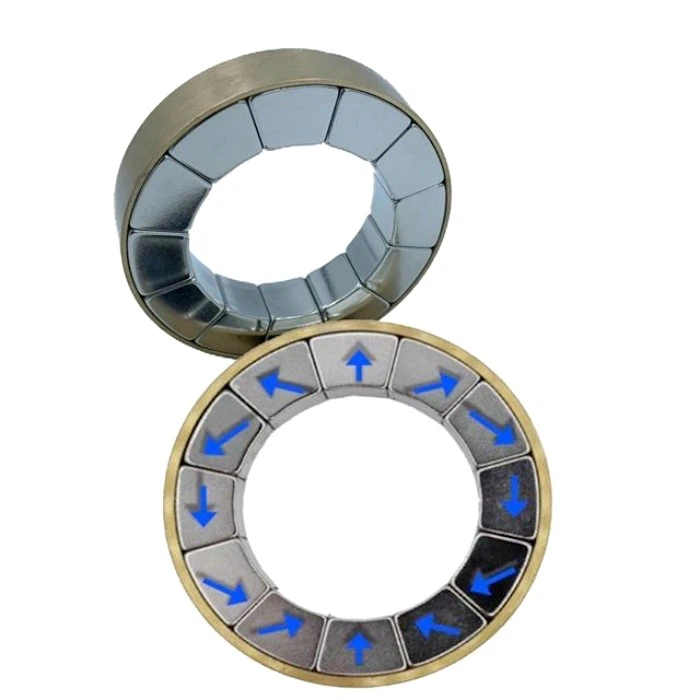
First things first, let's break down what a Halbach Array is. It's a special way of arranging magnets so that the magnetic field is significantly stronger on one side and almost zero on the other. This is achieved by orienting the magnets in a specific pattern, usually with the magnetization direction changing in a regular sequence.
The idea behind the Halbach Array was first introduced by physicist Klaus Halbach in the 1970s. He was working on creating better particle accelerators, but since then, the applications of Halbach Arrays have exploded. You can find them in electric motors, magnetic levitation systems, and even some high - tech scientific equipment.
Understanding the Basics of Magnet Orientation
The key to designing a Halbach Array lies in getting the magnet orientation right. Magnets have a north and a south pole, and in a Halbach Array, the orientation of these poles is carefully arranged. There are different types of Halbach Arrays, like the Linear Halbach Array, where the magnets are arranged in a straight line, and the Axial Flux Halbach Array, which is more circular in design.
For a linear Halbach Array, the magnetization direction of each magnet is incrementally rotated by a certain angle. Usually, the angle is 90 degrees or 180 degrees depending on the design requirements. This rotation creates a cumulative effect that boosts the magnetic field on one side of the array.
Let's say you're starting with a simple linear array. You'll want to have a clear plan for how the magnetization of each magnet will be oriented. You can use a magnetic simulation software to visualize how the magnetic field will look like based on different magnet orientations. This can save you a lot of time and effort in the long run.
Selecting the Right Magnets
Not all magnets are created equal, and choosing the right ones for your Halbach Array is crucial. You need to consider factors like the magnetic strength, the material, and the cost. The most commonly used magnets in Halbach Arrays are neodymium magnets. They're known for their high magnetic strength, which is great for creating a powerful magnetic field.
But neodymium magnets can also be quite brittle, so you have to be careful when handling them. Another option is samarium - cobalt magnets. They're more expensive than neodymium magnets, but they have a higher operating temperature and are less prone to corrosion.
When selecting magnets, you also need to think about their shape and size. The size of the magnets will affect the overall size of the array, and the shape will influence how they can be arranged. For example, rectangular magnets are easier to align in a linear array compared to round magnets.
Designing for Specific Applications
The design of your Halbach Array will depend heavily on its intended application. If you're using it in an electric motor, you'll want to optimize the design for maximum torque and efficiency. This might involve adjusting the number of magnets, the spacing between them, and the shape of the array.
For a magnetic levitation system, you'll need to create a very precise and uniform magnetic field. You may need to use a more complex arrangement of magnets to achieve the desired levitation effect. In this case, simulation tools can be really helpful in fine - tuning the design.
Let's take a look at the Halbach Array Assembly. This is the process of putting all the magnets together to form the array. You need to make sure that the magnets are properly aligned and firmly attached. You can use adhesives or mechanical fasteners to hold the magnets in place. But be careful when using adhesives, as some of them can affect the magnetic properties of the magnets.
Considering Environmental Factors
Don't forget about the environment in which your Halbach Array will be used. If it's going to be in a high - temperature environment, you'll need to choose magnets that can withstand the heat. As I mentioned earlier, samarium - cobalt magnets are a good choice for high - temperature applications.

If the array will be exposed to moisture or corrosive substances, you'll need to protect the magnets. You can use coatings or enclosures to prevent corrosion. This is especially important for neodymium magnets, as they're prone to rusting.
Prototyping and Testing
Once you have your design planned out, it's time to build a prototype. Building a prototype allows you to test your design in the real world and make any necessary adjustments. You can start with a small - scale prototype to save on costs.
During the testing phase, you'll want to measure the magnetic field strength and distribution. You can use a gaussmeter to measure the magnetic field at different points on the array. This data will help you determine if your design is working as expected. If the magnetic field is not strong enough or is not distributed evenly, you may need to go back to the drawing board and make some changes to the magnet orientation, spacing, or the number of magnets.
Pricing and Customer Needs
As a Halbach Array supplier, I know that pricing is a big concern for customers. The cost of a Halbach Array depends on several factors, such as the type of magnets used, the size of the array, and the complexity of the design. Neodymium magnets are generally more cost - effective than samarium - cobalt magnets, but as I said earlier, they have their limitations.
When working with customers, I always try to understand their specific needs. Some customers may need a high - performance array for a critical application, while others may be more budget - conscious. By understanding their requirements, I can recommend the best design and materials for their project.
Wrapping It Up and Reaching Out
Designing a Magnet Halbach Array is a combination of science, engineering, and a bit of creativity. It requires a good understanding of magnetism, careful selection of materials, and thorough testing. Whether you're working on an electric motor, a magnetic levitation system, or any other application, following these tips can help you create a successful Halbach Array.
If you're interested in sourcing a Magnet Halbach Array for your project, don't hesitate to get in touch. We've got the expertise and the resources to help you with your specific requirements. Whether you need a custom design or a standard product, we can work with you to find the best solution. Let's start the conversation and see how we can make your project a success.
References
- Halbach, K. (1973). "Design of permanent multipole magnets with oriented rare earth cobalt material". Nuclear Instruments and Methods, 106(3), 369 - 373.
- Jiles, D. C. (1991). Introduction to Magnetism and Magnetic Materials. Chapman and Hall.


