

Chongqing Great Wall Technology Co., Ltd. is one of the leading manufacturers and suppliers of magnet halbach array in China, also supports customized service. Welcome to wholesale high quality magnet halbach array for sale here from our factory.
A Halbach array is a unique configuration of alternating-polarity permanent magnets created to make the magnetic field on one side significantly stronger than the field on the other.
For example: The field below is lower than the field above.

Characteristics
1. Big Power Density
Halbach magnets design motors efficiently minimize motor size while improving motor power density when compared to conventional permanent magnet motor structures. This is due to the fact that when the Halbach magnetic ring was disassembled, the parallel magnetic field and the radial magnetic field overlapped, considerably enhancing the strength of the magnetic field on the opposite side.
2. The halbach array magnet rotor doesn't need a chute.
Due to the inescapable existence of air gap magnetic field harmonics, the fixed rotor structure of the conventional permanent magnet motor often takes the chute to reduce its impact. Due to the high air gap magnetic field sine distribution and low harmonic content of the Halbach motor, the stator lacks a chute.
3. A non-core material can be used to make this rotor.
Since there is no longer a requirement for the rotor to provide a path for the magnetic material, the unilateral magnetic field distribution created by the self-shielding effect of the Halbach magnet allows the system to have a lower moment of inertia and good attached performance.
4. Utilization of permanent magnets is high.
It improves the use of permanent magnets as the Halbach magnet is divided into magnetized outcomes, resulting in its permanent magnet operating is higher that normally more than 0.9.

Common Types
1. Cylinder Halbach Array
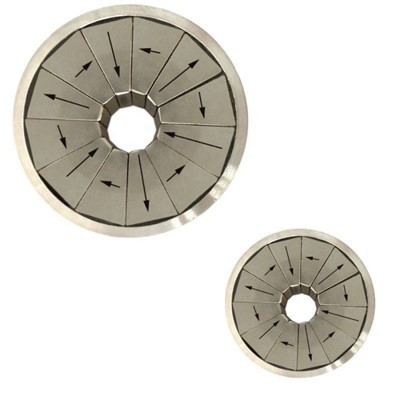
Traditional Halbach Array is a cylinder / ring with a dipole (2 pole) pattern in the central air gap. In the ring, the magnetic field is strong and homogeneous (parallel field lines) over the entire central hole.
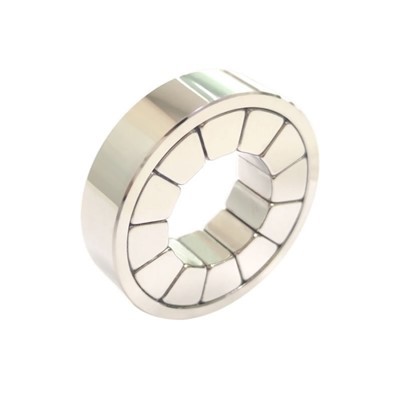
The NdFeB Halbach Array ring is constructed of 8 magnets (each with a distinct magnetization direction and arranged in 45 degree arc segments). Each segment of the arc is magnetized in such a way that the magnetic field travels through the central air gap before being 'directed' through and around the magnet material.


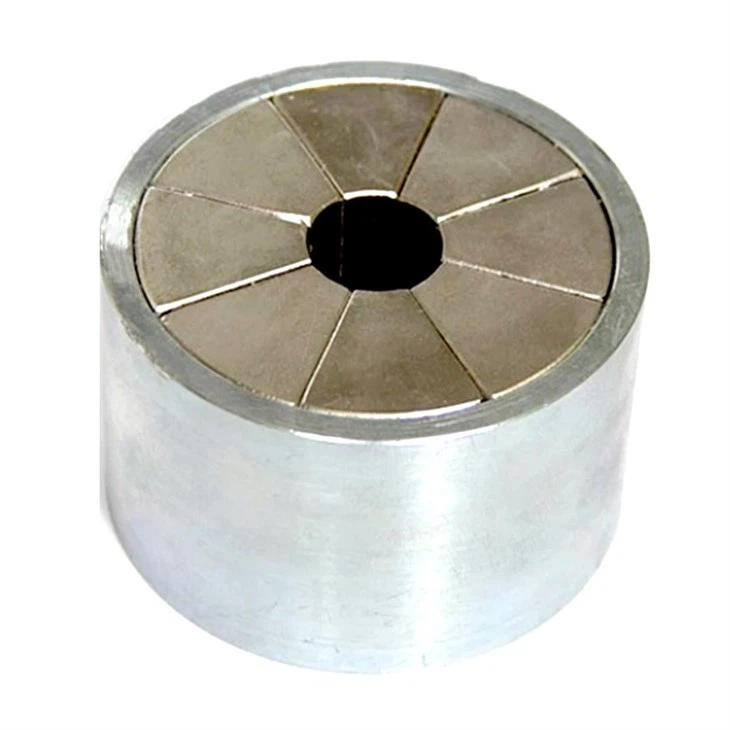
We provide a two pole, 110mm-diameter NdFeB Halbach array with a 30-mm-diameter central hole. Its axial length is 40mm. It employs conventional NdFeB (Neodymium Iron Boron) with a recommended working temperature of +80°C. At room temperature, the field in the middle of the air gap is at least 10,000 Gauss/one Tesla. The protective outer sleeve is made of brass.
We can also provide SmCo type. 16 magnets (22.5 degree arc segments, each with a unique magnetization orientation) make up the SmCo Halbach Array ring. Each segment of the arc is magnetized in such a way that the magnetic field travels through the central air gap before being guided through and around the magnet material. This specific array is unique since it is completely enclosed and employs cryogenic adhesive to enable operation at -269 degrees Celsius for liquid helium.
2. Block Halbach Array
The magnetic fields align above the plane of the composite structure when strips of alternatingly magnetized ferromagnetic materials (materials that can be permanently magnetized) are mixed, while the magnetic fields below the structure are in opposing directions and cancel out. The alternating magnetization components are actually 90°out of phase, or p/2.

The ideal situation, as indicated above, would result in no field below the plane and a field above the plane that is twice as large as it would be if the structure were uniformly magnetized. However, in practice, only a very modest field is generated on the underside and the ideal condition is never observed. Large arrays can be created by continuing this pattern forever.
John C. Mallinson made the initial discovery of these "one-sided flux" formations in 1973, describing them as "curiosities" with the potential to advance magnetic tape recording technology. But it wasn't until the 1980s when Berkley physicist Klaus Halbach independently found this magnetic phenomenon and developed Halbach arrays for use in particle accelerators that their true potential became apparent.In order to create powerful magnetic fields for focusing and guiding the particle accelerator beams, Halbach created the arrays using the ferromagnetic element cobalt.
Applications
Halbach arrays are presently employed in a variety of systems with varied degrees of complexity and have numerous applications. In refrigerator magnets, Halbach arrays are used in one of the most basic ways. In this instance, the magnet's holding power is increased by taking use of the one-sided flux features. Simple locking systems can also be made by combining variable arrays of magnetic rods. The flux confinement can be reversed by rotating each rod 90 degrees if the magnetizations of the rods are adjusted so that the field is maximized above the plane and minimized below it.
A Maglev train track, also known as an Inductrack, which uses magnetic levitation to support the carriage, is a more sophisticated example of a Halbach array in operation. The train is raised a short distance above the track by the magnetic arrays, which can support weights up to 50 times that of the magnet. The process is based on the induction principle; as the array is moved over the coils of a metallic track, changes in the magnetic field cause a voltage to be induced in the track. When the magnetic field produced by the track aligns with the field produced by the Halbach array, repulsion causes the train to levitate, much like when you try to push the two like poles of bar magnets together. Maglev trains are capable of providing high speed transportation because they are not hampered by many of the frictional forces that slow down conventional wheeled trains. In fact, the Japanese SCMaglev train system presently holds the Guinness World Record for the fastest rail transit after reaching 361 mph in 2003.
Halbach arrays, also referred to as Halbach "wigglers," are employed in cutting-edge scientific investigations carried out in synchrotrons and free electron lasers (FELs). FELs are employed in a wide variety of fields, from the medical to the military, and have a very broad and highly tunable frequency range. One of the fundamental parts of a FEL is a Halbach wiggler, which uses the magnetic field of the array to periodically 'wiggle' a beam of charged particles (typically electrons). The particles' acceleration changes as a result of the wiggling effect's alteration in particle direction. When coupled with an external laser source, this causes the emission of high intensity synchrotron radiation (photons).
Hot Tags: magnet halbach array, China magnet halbach array manufacturers, suppliers, factory, Magnet Halbach Array, Cylindrical Halbach Array, Halbach Array Arrangement, Halbach Array Magnet, Halbach Array, Halbach Array Assembly